Why can a relationship that once felt lifesaving eventually begin to feel limiting? Why does one partner’s growth sometimes feel like abandonment to the other? And why can two people who genuinely love each other become trapped in roles neither consciously chose?
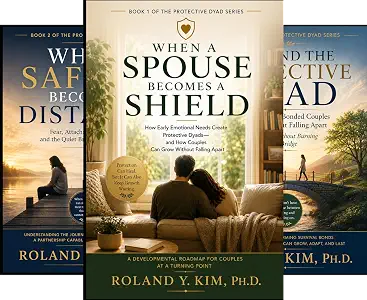
The Protective Dyad 6 book Series explores the hidden emotional architecture of intimate relationships—the unspoken arrangements through which partners provide safety, regulate fear and shame, protect vulnerable parts of one another, and create a shared emotional world.
Drawing on developmental psychology, attachment, trauma, and the Five-Stage framework of human development, Roland Kim, Ph.D., examines how relationships often become organized around needs that began long before the partners met. One person may become the protector, stabilizer, interpreter, or emotional shield, while the other relies upon that protection in ways neither fully recognizes.
These arrangements are not necessarily signs of dysfunction. They may be remarkably adaptive. A relationship can provide the safety that allows two people to build a marriage, raise children, pursue careers, survive hardship, and create a meaningful life together.
But what protects a relationship at one stage of life may constrain it at another.
When therapy, recovery, success, education, illness, aging, loss, or personal growth changes one partner, the couple’s old equilibrium may suddenly stop working. Growth can then be experienced not simply as change, but as betrayal: You are no longer being the person I needed you to be.
Across five volumes and six books, the series follows this developmental journey from protection to dependence, from dependence to the protective dyad, from the dyad to individual development, and finally to the hidden relationship pacts revealed in the lives of real historical couples.
At the center of the series is a hopeful proposition:
The goal is not to destroy the relationship that once protected us. It is to help the relationship develop beyond the conditions that originally made that protection necessary.
Partners do not have to choose between attachment and growth, or between loving another person and becoming more fully themselves. A mature relationship can gradually transform protection into partnership, dependency into differentiated connection, and an unconscious pact into a relationship that both people are free to choose.
What saved us was never meant to carry us forever.
The deepest task of love may be learning how to remain connected when neither person must remain small, frightened, dependent, or indispensable for the relationship.