
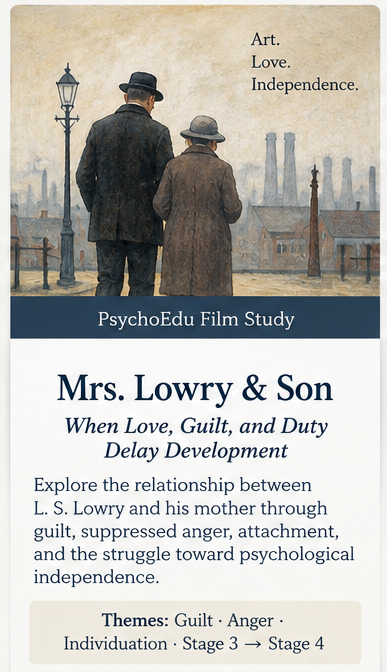
A PsychoEdu Conversation Inspired by Mrs. Lowry & Son
One of the most moving—and uncomfortable—questions raised by Mrs. Lowry & Son is whether Lowry remained devoted to his mother primarily because he loved her, because he felt responsible for her, or because he could not tolerate the guilt of separating from her.
Perhaps the most useful answer is: all of these may have been present at the same time.
Lowry does not appear simply dependent upon his mother. He works, paints, walks through his community, observes people closely, and develops a remarkably individual artistic vision. In many areas of his life, there is clearly a separate adult self.
Yet something seems to change when he is with his mother.
Her opinion matters enormously to him. Her inability to appreciate his art hurts him. He continues seeking recognition from her even when experience repeatedly suggests that she may not be able to provide the kind of validation he wants.
And yet he stays. He cares for her. He tolerates her criticism. He suppresses much of his disappointment.
When does caring for someone become different from being unable to separate from them?
Love and psychological freedom are not opposites
We sometimes imagine independence as physically leaving. But psychological independence can occur while two people remain deeply connected.
An adult son can care for an aging mother and still say, “I love you, but your criticism hurts me.”
He can say, “I understand that you do not value my painting the way I do.”
And eventually: “Your approval matters to me, but I cannot make my life depend upon receiving it.”
That would not necessarily represent abandonment. It could represent differentiation: the ability to remain emotionally connected to another person without requiring either person to surrender a separate self.
The developmental role of guilt
From a Five-Stage perspective, guilt is not inherently unhealthy. The capacity for guilt can represent an important developmental achievement. We become capable of recognizing that other people have feelings, that our actions affect them, and that relationships sometimes require responsibility and repair.
This capacity is central to what I describe as Stage 3 development.
But every developmental strength can become limiting when it becomes the only solution available. Responsibility can become over-responsibility. Loyalty can become self-sacrifice. Concern about another person’s feelings can gradually become fear of disappointing them.
Have I actually harmed someone—or have I merely disappointed them by becoming more separate?
Those experiences can feel remarkably similar to someone whose relationships have become organized around guilt.
And what happens to the anger?
This is another reason Lowry’s story interests me. His anger does not seem absent. Much of it appears unspoken.
When anger cannot become communication, it does not necessarily disappear. It can accumulate until it emerges in ways that surprise even the person experiencing it.
From a developmental perspective, anger has an important function. Healthy anger can eventually become language: “Stop.” “That hurt me.” “I disagree.” “I don’t want that.” “I am going to make a different choice.”
The developmental goal is therefore not simply to eliminate anger. It is to help anger become boundary, communication, and choice rather than destruction.
What might have been different?
Imagine Lowry being able to tell his mother:
“Mother, when you dismiss my painting, I feel deeply hurt because your opinion matters to me. But painting matters deeply to me as well, and I am going to continue.”
Something important happens in that statement. He neither attacks his mother nor submits to her. He acknowledges his attachment. He communicates his hurt. And he retains ownership of his choice.
In the Five-Stage framework, this represents movement toward Stage 4: differentiation and independence.
Independence does not have to mean, “I no longer need you.” It can mean:
“I can remain myself while remaining in relationship with you.”
And eventually, greater integration allows another possibility:
“I can understand why you feel as you do without requiring myself to become what you want me to be.”
Now I would like to hear what you saw
Films become especially valuable when different viewers notice different psychological truths.
How did you understand Lowry’s devotion to his mother?
Was it primarily love? Duty? Guilt? Fear of abandoning her? A developmental difficulty separating from her? Or do you think describing the relationship psychologically in these terms misses something important about his genuine devotion?
And perhaps the more personal question raised by the story is:
Can we disappoint someone we love without believing that we have betrayed them?
I welcome your thoughts in the comments below.
This PsychoEdu discussion is intended for education and personal reflection. Character interpretations are developmental perspectives, not clinical diagnoses of the historical individuals portrayed.
- Did you experience Lowry as psychologically dependent on his mother, or simply devoted to her?
- What did you make of his suppressed anger?
- Could he have become more independent without abandoning his mother?
- How might their relationship have changed if he had communicated his disappointment more directly?
- Can We Disappoint Someone We Love Without Betraying Them?
- Do you agree that his difficulty reflects a Stage 3 → Stage 4 developmental challenge?
- Did you see something in the film that the PsychoEdu analysis overlooked?
Your turn
There is no requirement to agree with the PsychoEdu interpretation. Different readings are welcome. Please share what you saw in the characters and their relationship in the comments below.
Please discuss characters and ideas respectfully. Personal experiences may be shared if you wish, but this forum is for psychoeducation and discussion rather than psychotherapy or clinical advice.
← RETURN TO MRS. LOWRY & SON STUDY