
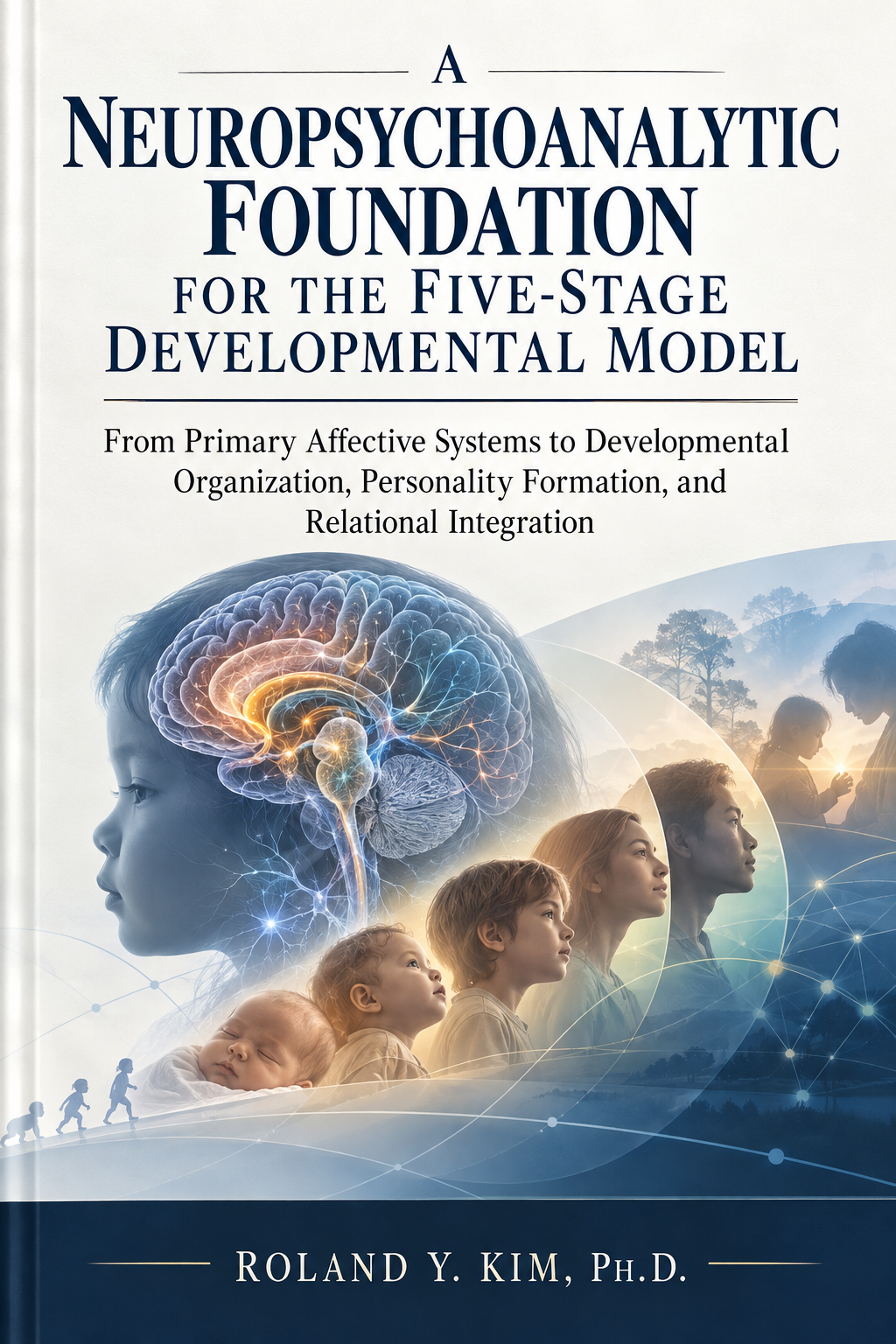
A Neuropsychoanalytic Foundation for the Five-Stage Developmental Model
Roland Y. Kim, Ph.D.
About This Book
Integrating neuroscience, psychoanalysis, and attachment theory, this book explores how early emotional experiences shape personality, relationships, and psychological development. It introduces the Five-Stage Developmental Model, connecting fear, shame, guilt, independence, and empathy to the lifelong processes of emotional growth, trauma, and relational integration.
What You Will Explore
The book examines primary affective systems, affective consciousness, attachment, implicit emotional learning, and the development of relational capacities. It considers how these bodies of research may inform a five-stage developmental interpretation of emotional organization, personality formation, and psychological integration.
A Developmental Question
How might early emotional experience influence the ways we seek safety, protect our agency, repair relationships, establish independence, and develop empathy?
Scholarly note: The Five-Stage Developmental Model is an integrative theoretical framework, not an empirically established sequence of discrete neural stages. The book distinguishes research findings from interpretations and original hypotheses.